Search Icon





Evolutionary paleogeneticist Beth Shapiro travels to the cold reaches of the world to find DNA samples of long extinct animals, such as mastodons and saber-toothed tigers. She hopes to learn …

“The infinite! No other question has ever moved so profoundly the spirit of man,” said David Hilbert, one of the most influential mathematicians of the 19th century. A subject extensively studied by philosophers, mathematicians, and more recently, physicists and cosmologists, infinity still stands as an enigma of the intellectual world.

Humans work together on enormous scales to build complex tools as large as cities and create social networks that span the globe. What is the key to our success? This …

Meet “Barf” the turkey vulture and learn from Tanya Lowe what it’s like to be a conservationist. Episode filmed live at the 2015 World Science Festival in New York City. The …

Acknowledging the scientists who blazed intellectual trails before him, Isaac Newton wrote: “If I have seen a little further it was by standing on the shoulders of giants.” In this …
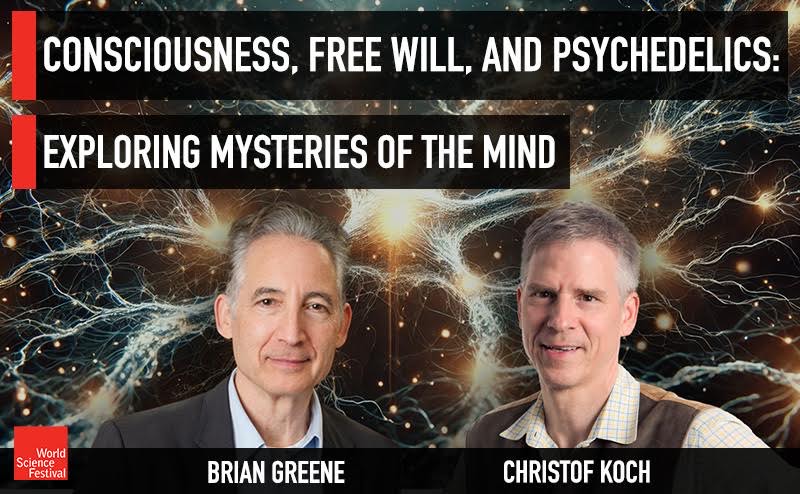
World renowned neurophysiologist and computational neuroscientist Christof Koch joins Brian Greene to discuss how decades of experimental and theoretical investigation have shaped his understanding of consciousness and the brain — …